




Company Formation Malta
Establishment of your Malta company including tax structure, bank account, and registration.
Learn more
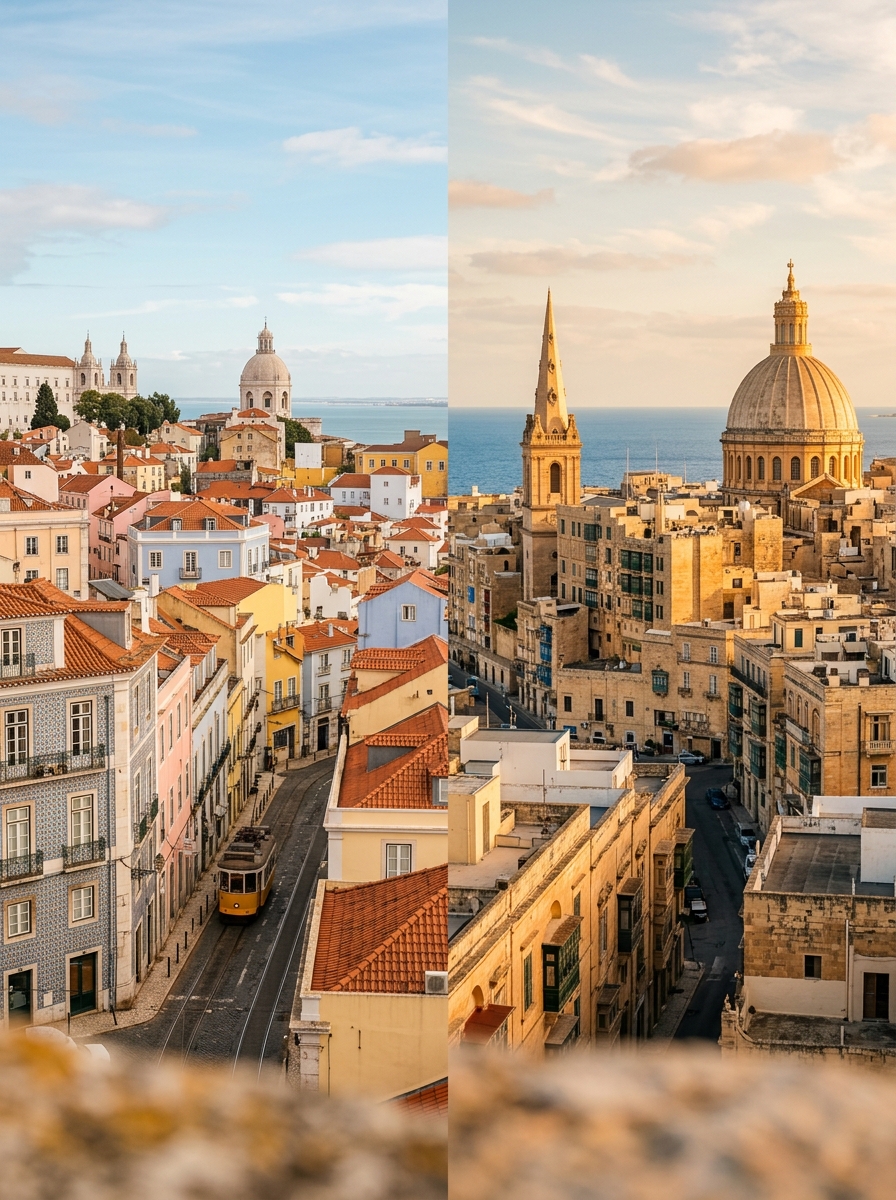
Jurisdiction Comparison
The NHR regime closed at the end of 2024. Its successor, IFICI, targets only specific professions. For UK and international entrepreneurs who previously considered Portugal, the landscape has fundamentally changed.
Independent Analysis · Based in Malta since 2013
For years, Portugal was an attractive destination for international taxpayers thanks to the NHR regime. Since late 2024, the NHR is closed, and its successor (IFICI) applies only to highly qualified professionals in specific sectors. For UK entrepreneurs and freelancers seeking a broadly applicable tax programme, Portugal has lost much of its appeal. Malta offers a predictable alternative with its refund system (5% effective corporate tax), the FITWI regime (15% flat rate without industry restrictions), and an active Double Tax Treaty with the UK. Both are EU members, but their tax frameworks differ significantly following the end of the NHR.
Closed
NHR Status
Since late 2024, transition period ended March 2025
21%
Portugal Corporate Tax
Standard rate, up to 31.5% with surcharges
5%
Effective Malta Corporate Tax
Via EU-compliant refund system
Both EU
EU Membership
Both countries are full EU members
Direct Comparison
Portugal
Malta
Corporate Tax
21% standard rate. With Municipal and State Surcharges, up to 31.5% on high profits.
35% nominal. 5% effective rate via the EU-compliant refund system (6/7ths refund).
Special Tax Programme
IFICI (NHR successor): 20% flat tax on Portuguese employment income. Only for qualified professionals in science, tech, and healthcare. Not broadly available for entrepreneurs.
FITWI regime: 15% flat rate for individuals, no industry restrictions, minimum tax of EUR 15,000/year. Available to all professions.
Personal Income Tax (PIT)
Progressive up to 48%. Without a special programme, full taxation under regular Portuguese law applies.
Progressive up to 35%. The FITWI regime allows a 15% flat rate for qualifying new residents.
Crypto Taxation
Capital gains from crypto are tax-free after a 365-day holding period. Shorter holding periods face a 28% flat tax. A genuine advantage for long-term crypto investors.
Long-term crypto gains for private individuals are generally tax-free. Commercial crypto trading is subject to regular corporate taxation.
EU Membership
Yes. Full single market access, freedom of services, EU regulatory framework.
Yes. Full single market access, freedom of services, EU regulatory framework.
DTT with the UK
Active Double Tax Treaty with the United Kingdom.
Active Double Tax Treaty with the United Kingdom (SI 1995/763).
Residency Permits
D7 visa (passive income), Golden Visa (funds only, from EUR 500,000; real estate route largely closed). EU citizens do not need a visa.
EU citizens: local registration. Non-EU nationals: Single Permit or Residency Programmes. Fast processing times.
Banking for UK Clients
Solid. EU-regulated banking system. Account opening is predictable but can be more time-consuming than in Malta.
Solid. EU-regulated, MFSA oversight. Account opening is predictable and well-established for international clients.
Cost of Living
Moderate to affordable. Lisbon is more expensive than the rest of Portugal. Overall, well below UK cost of living.
Moderate. Lower than London, comparable to southern European standards. Prime real estate is more expensive than rural Portugal.
Language / Authorities
Portuguese. Administrative processes are often in Portuguese; English is increasingly accepted but not universally.
Maltese and English. All official processes are in English. No language barrier.
Since 2009, the Non-Habitual Resident (NHR) regime was Portugal's main draw. Foreign arrivals paid a flat 20% tax rate on certain Portuguese income for ten years, while many foreign income sources were completely exempt. For UK entrepreneurs, freelancers, and retirees, this was a highly compelling offer.
Add to this the high quality of life: Lisbon and the Algarve offered a mild climate, lower living costs than the UK, and a growing international community. Portugal was attractive not just for tax reasons, but as a place to live. Many UK expats put down roots there.
The business infrastructure also improved: coworking spaces in Lisbon and Porto, a growing startup ecosystem, and relatively straightforward residency options via the D7 visa or Golden Visa programme made relocating easy.
This all changed when the Portuguese government announced the end of the NHR regime in 2023, closing it permanently at the end of 2024. The final transition period expired in March 2025. What remains is no longer sufficient for most UK and international entrepreneurs.

The NHR regime was the tax backbone for many international arrivals in Portugal. The exemption of foreign income and the 20% rate on certain Portuguese income made the jurisdiction attractive even for entrepreneurs who didn't meet specific industry requirements. With the end of the NHR, this foundation is gone. Anyone moving to Portugal now, without qualifying for IFICI, is subject to regular progressive income tax up to 48%.
The IFICI (Incentivo Fiscal à Investigação Científica e Inovação) is the successor to the NHR, but with a significantly narrower scope. It targets qualified professionals in science, technology, research, and healthcare. The 20% flat tax remains, but the pool of eligible individuals has shrunk drastically. Independent entrepreneurs, consultants, e-commerce operators, or digital independents generally do not qualify.
On the corporate side, the standard corporate tax rate remains at 21%, which can rise to 31.5% with Municipal and State Surcharges on profits over EUR 1.5 million. This is significantly higher than Malta's effective 5% rate under the refund system. While Portugal offers a participation exemption for holding companies, this alone does not make it an attractive base for active trading companies.
One point often overlooked in comparisons: bureaucracy in Portugal remains challenging despite recent improvements. Administrative processes are predominantly in Portuguese, and waiting times for NIF numbers and residency permits can stretch to several months. Malta offers a practical advantage here with English-speaking authorities and predictable timeframes.
“Since the NHR regime ended, we've received a significant increase in enquiries from entrepreneurs who originally planned to move to Portugal. The disappointment is understandable. But an honest comparison shows that for most UK and international entrepreneur profiles, Malta was structurally the better choice even before the NHR closed.”
Dr. Jörg Werner
Founder, Dr. Werner & Partners
Portugal remains an attractive destination if tax planning is not your primary motive. Those choosing Portugal for its quality of life, climate, and culture - and who are prepared to pay regular Portuguese taxes - will find it an excellent place to live. It also remains appealing for long-term crypto investors thanks to the tax exemption after a 365-day holding period. Furthermore, qualified scientists or tech professionals who meet the IFICI criteria still benefit from the 20% rate.
Malta is the more stable choice for entrepreneurs seeking a predictable tax structure that doesn't depend on narrow professional qualifications. The refund system, offering an effective 5% corporate tax rate, is open to all industries. The FITWI regime, with its 15% flat rate for individuals, is not restricted to specific sectors. Additionally, the active Double Tax Treaty with the UK provides legal certainty when relocating.
For UK entrepreneurs with ongoing business in the UK or across Europe, both jurisdictions offer EU access. However, Malta combines this EU access with a significantly lower effective corporate tax burden and broader access to special tax programmes for individuals. If you want to set up an active company and build genuine substance, Malta offers the better combination of tax efficiency, administrative ease, and English-speaking infrastructure.
In short: Portugal suits lifestyle-driven expats and long-term crypto investors. Malta is the right fit for entrepreneurs who need an industry-agnostic tax structure, DTT protection, and English-speaking authorities.
The IFICI came into force in 2024 as the successor to the NHR, continuing to offer a 20% flat tax on qualifying income in Portugal. The crucial difference: the target audience is radically restricted. The IFICI is aimed at professionals in science and research, technology and innovation, university professors, and qualified healthcare roles. Entrepreneurs, freelancers, consultants, and digital independents are generally not eligible.
The framework conditions have also changed. The generous exemption for foreign income that made the NHR so attractive is much more limited under the IFICI. Those who do not fall into one of the defined professional categories are subject to the regular Portuguese tax system with rates up to 48%. For the vast majority of UK expats, the IFICI is therefore not an equivalent replacement.
By comparison: Malta's FITWI regime offers a 15% flat rate on foreign income remitted to Malta, with a minimum tax of EUR 15,000 per year. It is not tied to any specific profession. Anyone moving their tax residence to Malta who meets the criteria can use the programme, regardless of whether they are an entrepreneur, consultant, investor, or retiree.
We regularly advise clients who already live in Portugal or whose NHR status has expired, and who are now considering whether Malta is the better long-term option. Relocating from Portugal to Malta is relatively straightforward within the EU, but it requires careful tax planning.
Key questions include: When does your unlimited tax liability in Portugal end? Are there exit tax rules that apply upon departure? How will your corporate structure be transitioned? Under certain conditions, Portugal levies a tax on unrealised capital gains when you leave. The exact implications depend on your individual asset portfolio and length of stay.
The relocation process follows a clear pattern: analysing your tax position in Portugal, planning the Maltese structure (company formation, refund setup, residency permits), coordinating the move with tax support in both jurisdictions, and establishing ongoing compliance in Malta. In a free initial consultation, we can assess whether a move makes commercial sense for your situation.


We analyse your business model, target markets, and current tax position in your home country. You receive a clear, actionable recommendation.
Together, we design the optimal corporate structure: holding company, trading entity, and refund setup, tailored to your specific situation.
We handle the entire incorporation process: Articles of Association, registration, tax enrolment, and bank account opening. Timeframe: 6-8 weeks.
Managing your move: residency permits, registration, national insurance, and finding accommodation. End-to-end support.
Bookkeeping, annual accounts, tax returns, and refund applications. We remain your dedicated point of contact for all tax and legal matters.

In a free initial consultation, we will analyse your business model and determine whether Malta is the better choice for your situation. Honest, confidential, and with no sales pressure.
Establishment of your Malta company including tax structure, bank account, and registration.
Learn more
Tax structuring for international entrepreneurs. Treaty optimisation, refund system, exit tax planning.
Learn more
Residence permit, change of residence, and integration. From registration to social security.
Learn more
Senior New Business Manager
Company Formation · Tax Structuring

Tax Transformation Leader
Tax Advisory


Transparency matters to us. Here you will find answers to the most common questions on this topic.
No. The NHR regime was permanently closed at the end of 2024. The final transition period for applications initiated before the deadline expired in March 2025. Anyone moving to Portugal now falls under the regular tax system or must qualify for the much narrower IFICI programme.
The IFICI targets qualified professionals in science, research, technology, innovation, university teaching, and specific healthcare roles. The exact criteria are defined by a positive list of professions. Independent entrepreneurs, consultants, and e-commerce operators generally do not qualify. Approval is granted by the Portuguese authorities on a case-by-case basis.
That depends on your individual situation. If your NHR status has expired or you do not qualify for the IFICI, moving to Malta can offer significant tax advantages. Malta provides a 5% effective corporate tax rate via the refund system and a 15% flat rate under the FITWI regime, both without industry restrictions. We can evaluate your specific situation in a free initial consultation.
Both locations offer a Mediterranean climate, good infrastructure, and an international community. Portugal boasts a larger landmass, diverse nature, and a broad culinary scene. Malta offers shorter distances, English as an official language, and a compact, well-connected expat community. The choice here is personal, not tax-driven. If tax structuring is your main priority, Malta provides the better framework.
Our expertise is strictly focused on Malta. We do not advise on Portuguese tax law and do not set up companies in Portugal. However, we will assess your situation and give you an honest appraisal of whether Malta is the better option for your profile. If Portugal is objectively a better fit for you, we will tell you. The initial consultation is free and confidential.
Next step
In a free initial consultation, we will analyse your business model and determine whether Malta is the better choice for your situation. Honest, confidential, and with no sales pressure.

Roderick Galea
Managing Partner

Nathaniel Borg
Partner



and the team in Malta

Corporate Services at DW&P Dr. Werner & Partners are provided by DW&P Services Ltd. (C 103208) which is regulated by the MFSA and is licensed under Authorised Person ID: DSER-23577 to carry out the activities of a Class C CSP in terms of the Company Services Providers Act (Cap. 529 of the Laws of Malta).


