An entrepreneur moving with their own limited company has different questions from a family with school-age children or a retiree drawing a UK State Pension. This guide starts with what applies to everyone. After that, each situation has its own section.
At a glance
- 90 days: EU and Irish citizens who stay longer register and receive a Maltese ID card. UK citizens may stay visa-free for up to 90 days in any 180-day period across the Schengen area, which includes Malta; a longer stay needs a Maltese residence permit.
- 183 days in Malta or your centre of life there make you tax resident.
- EUR 5,000 minimum tax for non-doms with foreign income of EUR 35,000 or more that is not fully remitted to Malta.
- EUR 0 wealth, inheritance and gift tax in Malta.
Residence: registration after 90 days or a permit
Malta has been an EU member state since 2004. As an EU or Irish citizen, you may live and work there without a visa. If you stay longer than three months, you register with Identità (formerly Identity Malta) and receive a Maltese ID card, also known as the eResidence card. For EU citizens it is free of charge.
For the application you need a residential address confirmed by your landlord and proof of how you support yourself: an employment contract or sufficient means of your own. Allow several weeks from application to card. You will then need the ID card number for tax, your bank, the doctor and your driving licence. The card is not a travel document, however, so keep your passport for flights.
UK citizens are no longer covered by EU free movement. Without a permit, you may stay for up to 90 days in any 180-day period, counting all days in the Schengen area. If you moved to Malta before 1 January 2021 and have lived there legally since, you keep your rights under the Withdrawal Agreement. Anyone arriving now needs a Maltese residence permit, for example an employment-related or non-employment-related permit from Identità, the Nomad Residence Permit from Residency Malta Agency, or residence under the Malta Retirement Programme. Which documents you need depends on the route.
When you become tax resident in Malta
You are tax resident in Malta if you spend more than 183 days of the calendar year there or have your centre of life there. The centre of life is what counts, not the number of days alone. Evidence includes your home, your registration, your ID card and a daily life clearly based in Malta.
Whether you are still UK resident is decided separately, under the UK's Statutory Residence Test. It combines automatic tests with the ties you keep to the UK. In the year you leave, the UK tax year may be split into a UK part and an overseas part.
The non-dom principle
If you are resident in Malta but domiciled elsewhere, you are a non-dom. Put simply, domicile is your permanent home in the legal sense, and people who move to Malta usually keep the domicile of their country of origin. Non-doms are taxed on the remittance basis: Malta taxes Maltese income, and foreign income only to the extent that it is remitted to Malta. This is Malta's own rule. It is separate from the former UK non-dom regime; the UK remittance basis can no longer be claimed from 6 April 2025.
Non-doms with foreign income of EUR 35,000 or more a year who do not remit all of it to Malta pay a minimum tax of EUR 5,000 a year. Malta levies no wealth tax and no inheritance or gift tax.


What the UK still wants after you leave
Moving to Malta does not by itself end your UK tax obligations. Deal with these points before you leave:
- Residence and ties: The Statutory Residence Test looks at your days in the UK and the ties you keep. A home you keep in the UK can play a part, so check your position before you leave. Tell HMRC that you are leaving, either with form P85 or in your Self Assessment return.
- UK income: Income from UK sources can remain taxable in the UK, for example rent from a UK property. Under the Non-Resident Landlord Scheme, you can apply with form NRL1 to receive that rent without UK tax deducted.
- Inheritance tax: If you were a long-term UK resident, meaning resident for at least 10 of the last 20 tax years, UK inheritance tax can still apply to your worldwide estate for 3 to 10 tax years after you leave.
- Gains on shares: Leaving does not in itself trigger capital gains tax on your shares. If you return within five years, however, the temporary non-residence rules can tax gains and certain distributions from your time abroad. The Entrepreneur and Private individual sections explain the details.
Which state may tax which income is governed by the double taxation convention between the United Kingdom and Malta. A double taxation convention (or treaty) is an agreement between two states that prevents the same income from being taxed twice. The UK-Malta convention was signed in 1994 and has been in force since 27 March 1995. For Irish residents, the Ireland-Malta treaty applies instead.
What life in Malta costs
Rent is the largest item. Flats are usually let furnished, and a first tenancy often runs for no more than a year.
| Area | Rent for a one-bedroom flat, approx. per month (2026) |
|---|---|
| Gzira, San Gwann, Msida | EUR 1,200 |
| Sliema, St. Julian's | EUR 1,500 |
| Seafront, upmarket areas | from EUR 2,000 |
Rents are lower on Gozo and away from the well-known towns. Many journeys can be made by bus. Residents with a personalised Tallinja Card currently travel free on most routes, but eligibility narrows from January 2027 and depends on your residence status, so check whether it applies to you.
Your situation
Choose the tab that describes your situation. If more than one applies, for example as an entrepreneur with a family, read both.
Entrepreneurs: setting up a company, planning your departure


For entrepreneurs, the decisive tax point is usually the departure from the UK. If you hold shares in your own company, check the temporary non-residence rules before you start thinking about a Malta structure.
How Malta taxes companies
A Maltese company pays 35% corporate tax. When it distributes profits, its shareholders can claim back a large part of that tax; for active trading profits the refund is 6/7. This refund system usually leads to an effective tax burden of around 5%. The actual rate depends on your structure and your income and is not guaranteed.
In addition:
- The standard rate of VAT is 18%.
- Controlled foreign company (CFC) rules have applied since 2019. They prevent profits from being parked in companies with no activity of their own.
A sound Malta structure therefore relies on real substance: an office, management and decisions on the island. A company that exists only at an address does not hold up for tax purposes.
What you pay yourself as a director
Many entrepreneurs are employed by their own Maltese company. Their salary is then Maltese income and is taxed at progressive rates of up to 35%. Social Security Contributions (SSC) are payable on top: 10% each from employee and employer. The self-employed pay 15%.
An employment contract with your own company is also the most common proof for the ID card if you are an EU citizen. If you are a UK citizen, it supports your residence permit application.
Leaving the UK: what to settle before you go
Leaving the UK does not in itself make you pay capital gains tax on your shares. According to HMRC, gains made in tax years after you leave are generally not chargeable unless your non-residence turns out to be temporary. Gains on UK land and property, and on shares in UK property-rich companies, remain chargeable for non-residents. Temporary non-residence is the point to plan for:
- Who is affected: you were UK resident in at least 4 of the 7 tax years before you left, and you are non-resident for 5 years or less.
- What is taxed: gains on assets you already held when you left and disposed of while abroad are taxed in the tax year you return.
- Distributions: distributions from a close company in which you are a material participator are also caught. Dividends paid out of trading profits that arose during your absence are not.
If your company itself ceases to be UK resident, it is treated as disposing of its assets at market value (section 185 of the Taxation of Chargeable Gains Act 1992). Assets of a permanent establishment that stays in the UK are excepted.
The route to Malta in four phases
- Free 30-minute initial consultation We review your situation, even if Malta turns out not to be the right fit.
- Analysis and concept Your individual Malta structure and a transparent proposal.
- Implementation Company formation, bank account, work permit and residence permit, relocation. An operational company is typically set up in 6 to 8 weeks; this range is not a guarantee and depends on the individual case.
- Ongoing support Accounting, statutory audit, compliance and payroll.
Book your free initial consultation
DW&P has been active in Malta since 2013 and holds the MFSA CSP Class C licence, the highest licence level Malta grants to corporate service providers.
How we support you
Before you move, our international tax advisory team checks how the temporary non-residence rules affect your shareholding. We then take care of company formation in Malta, building substance with an office and local management, your bank account and your move to Malta. Once the business is running, we handle accounting, payroll and compliance.
Plan the company and your departure together.
In 30 minutes we look at your shareholding, the temporary non-residence rules and the right route to Malta.
Free initial consultation

You will speak with Horst Wickinghoff Senior New Business Manager
- 30 minutes
- By video call
- Free, no obligation
Employees: moving to Malta with an employment contract


As an EU or Irish citizen, you need neither a visa nor a work permit to take up a job in Malta, and a signed employment contract is also the key proof for your ID card. As a UK citizen, you need a Maltese employment-related residence permit, which your employer usually applies for.
Where the jobs are
Demand is strongest in IT, online gaming, financial services, sales, marketing and customer service. Multilingual staff are particularly sought for customer service roles covering other European markets. The working language is usually English. Compare the salary on offer with the rents in the place you plan to live.
Many offices are in Gzira, Ta' Xbiex and Msida. If you work there, living nearby saves you a commute through heavy traffic.
Tax and social security
Your salary for work in Malta is Maltese income. It is taxed at progressive rates with a top rate of 35%; low incomes remain tax-free. Your employer deducts the tax directly from your pay.
You also pay Social Security Contributions (SSC), Malta's social security: you and your employer each pay 10% of your salary. Access to public healthcare is linked to your contributions or to other eligibility routes.
Healthcare
With a job in Malta, you have access to the public health system. When you register, you are usually asked for your payslips from the last 3 months. The main hospital is Mater Dei Hospital in Msida. You can also see a private doctor at your own expense.
What to settle before you move
- Severance pay and workplace pension: When and where they are taxed depends on when they are paid out. Clarify this before you leave.
- Telling HMRC: There is no formal deregistration in the UK. Tell HMRC that you are leaving, either with form P85 or in your Self Assessment return. A home you keep in the UK can affect whether you remain UK resident.
- Qualifications: Whether your professional qualification is recognised depends on the profession. Check with the Maltese body that regulates your profession.
How we support you
For your move to Malta, we guide you through registration and your ID card or residence permit, and we help you open your bank account. Through our international tax advisory, we clarify before you leave when and where severance pay and your workplace pension will be taxed.
Get the timing right before you move.
In 30 minutes we go through severance pay, your workplace pension and leaving the UK with you.
Free initial consultation
You will speak with Horst Wickinghoff Senior New Business Manager
- 30 minutes
- By video call
- Free, no obligation
Families: school, housing and tax as a couple
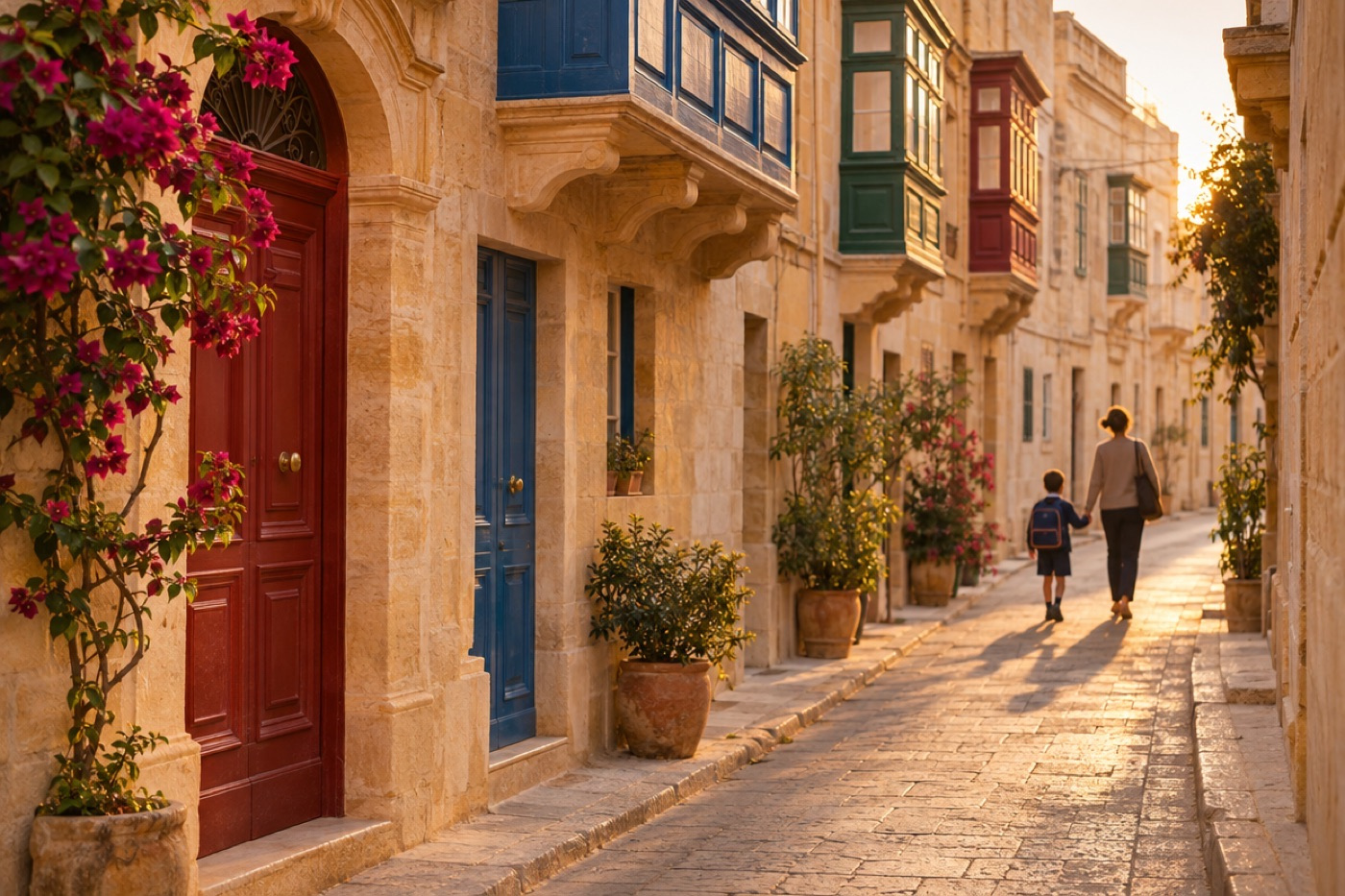

If you move to Malta with a partner and children, three questions shape daily life: which school, where to live and how Malta taxes you as a couple. Settle the school question first, because popular private schools have waiting lists.
School and childcare
Schooling in Malta is compulsory up to the age of 16. The school system has three stages:
| Stage | Age |
|---|---|
| Primary school | 5 to 11 years |
| Secondary school | 11 to 16 years |
| Sixth form | 16 to 18 years |
You have three options:
- State schools are free. Lessons are taught in English and Maltese.
- Church schools are an established part of the education system.
- International schools teach entirely in English and cost several thousand euros a year. For popular schools, enquire early.
For younger children there are childcare centres, although they may be some distance from home. Where both parents work, many families also use a nanny or an au pair.
How Malta taxes you as a couple
Malta has its own tax rates for married couples and for single parents. For non-doms, two points stand out:
- Minimum tax once per couple: If, as a married couple, your joint foreign income reaches EUR 35,000 a year and you do not remit all of it to Malta, the minimum tax of EUR 5,000 is due once for both of you.
- A spouse domiciled in Malta: If one spouse is resident and domiciled in Malta, Malta taxes both spouses on their worldwide income, and the remittance basis no longer applies.
Malta levies no inheritance or gift tax. If you were a long-term UK resident, however, the UK can still charge inheritance tax on your worldwide estate for 3 to 10 tax years after you leave.
Residence without employment
If nobody in the family works in Malta, EU and Irish citizens show sufficient means of their own for the ID card, together with private health insurance that covers them as Malta residents. How much wealth is required depends on marital status and the number of dependants; have the current amount checked before you apply. For UK citizens, the requirements depend on the permit route.
Housing with children
In places such as Mosta, Rabat or Marsaskala, and on Gozo, families find larger flats at lower rents than in Sliema or St. Julian's. Ideally, choose where to live based on the school, not the other way round.
Health and childbirth
The main hospital is Mater Dei Hospital in Msida; emergencies from private clinics are also taken there. You can give birth there as a public patient or in a private clinic.
How we support you
For your move to Malta, we guide your family through registration and the ID card or residence permit. Through our international tax advisory, we work out how Malta taxes you as a couple and what the UK still charges on inheritance. We also help you open a bank account in Malta.
Plan the move as a family.
In 30 minutes we look at schooling, where to live and how you are taxed as a couple.
Free initial consultation
You will speak with Horst Wickinghoff Senior New Business Manager
- 30 minutes
- By video call
- Free, no obligation
Retirees: which pension is taxed where
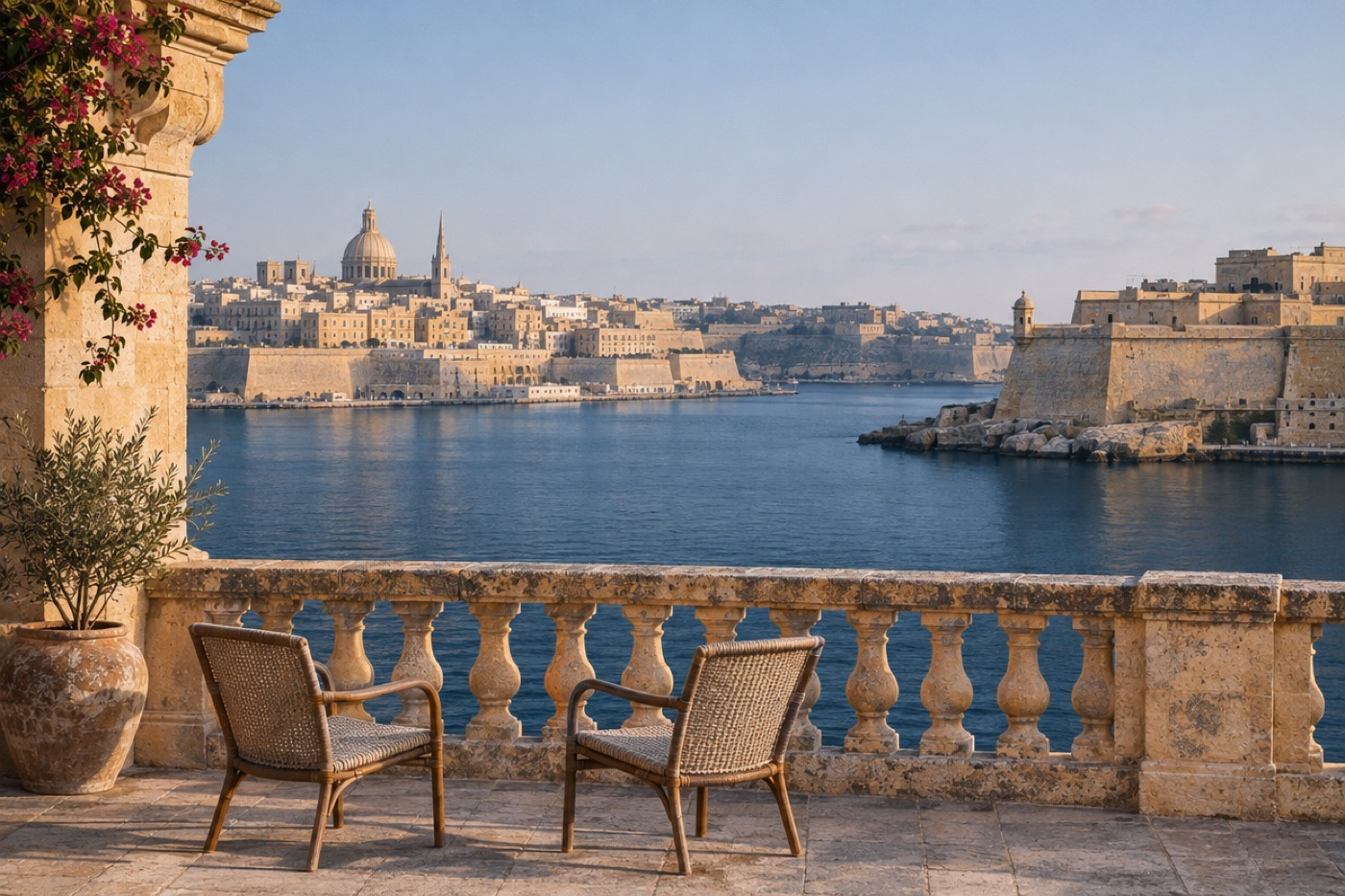

How much you pay in the end depends above all on what your retirement income consists of. The double taxation treaty decides which state may tax each pension, and not every pension is treated the same way. Your UK State Pension in particular needs an individual check.
Which state taxes which pension
The double taxation convention between the UK and Malta allocates each type of income to a state:
| Income | Taxed in | Treaty rule |
|---|---|---|
| Government pension (for example civil service) | UK; Malta only if you are resident there and a Maltese national | Art. 19(2) |
| Private and workplace pensions, annuities | Generally only Malta, as your state of residence; check how your pension is classified | Art. 18(1) |
| UK State Pension | Needs individual review | – |
| Foreign interest and dividends | Malta, for non-doms only to the extent remitted | – |
If you are moving from Ireland, the Ireland-Malta treaty applies: the Irish State Pension is taxed only in Ireland (Art. 18(2)), while private pensions and annuities are taxed in the state of residence (Art. 18(1)).
Lump sums and severance payments can be treated differently. Clarify how they are classified before they are paid out.
What continues in the UK
Your UK pensions continue to be paid after the move, and HMRC and the Department for Work and Pensions (DWP) remain involved:
- Treaty relief: Non-residents receive UK pensions through their usual pension payer. Where the treaty gives Malta the taxing right, you claim relief from UK tax at source with form DT-Individual.
- State Pension abroad: The UK State Pension is payable in Malta and is uprated each year, because Malta is part of the EEA.
- Life certificate: The DWP may send you a life certificate. If you do not return it, payments may be suspended.
What Malta taxes
Malta exempts pensions from tax up to an annual cap once you are at least 61 years old. This also applies to foreign pensions that Malta is entitled to tax. The cap is adjusted with the budget; we give you the current figure in the initial consultation.
As a non-dom, you pay no tax in Malta on foreign capital gains. Foreign interest and dividends are taxed to the extent that you remit them to Malta.
The Malta Retirement Programme
The Malta Retirement Programme is a separate tax status for retirees, administered by the Malta Tax and Customs Administration (MTCA). You pay 15% on foreign income that you remit to Malta. One of the conditions is that your pension makes up at least 75% of your chargeable income. For UK citizens, the programme can also be the basis for living in Malta. For applications from 2027, the conditions change significantly:
| Condition | Application by 31 December 2026 | Application from 1 January 2027 |
|---|---|---|
| Minimum tax per year | EUR 7,500 plus EUR 500 per dependant | EUR 15,000 |
| Application fee | EUR 2,500 | EUR 8,500 |
| Property purchase | from EUR 275,000 (Gozo and the south from EUR 220,000) | from EUR 700,000 |
| Rent per year | from EUR 9,600 (Gozo and the south from EUR 8,750) | from EUR 14,000 |
From 1 January 2027, new applications fall under the Individual Tax Programme Rules, 2026 (Legal Notice 195 of 2026), which introduce a retired pensioner status. Status granted on applications received by 31 December 2026 continues until 31 December 2031. We confirm the terms that apply to you in the initial consultation.
The programme is not worthwhile for everyone. Whether it pays off depends on which of your pensions Malta may tax at all. For many EU citizens, the ordinary non-dom status without an application fee is enough.
Health insurance
If you receive a UK State Pension or another exportable UK benefit and live in Malta, you may be entitled to healthcare paid for by the UK. Apply for an S1 form and register it with the Entitlement Unit in Malta. This gives you access to public hospitals and health centres. A UK-issued GHIC or EHIC covers temporary visits, not living in Malta. You cannot get an S1 if you also receive a state pension from the country where you live. If you have private cover, check whether your policy covers permanent residence in Malta.
How we support you
Through our international tax advisory, we assign each of your pensions to the right state and check whether the Malta Retirement Programme is worthwhile for you. For your move to Malta, we guide you through registration and the ID card or residence permit.
Know in advance where your pension will be taxed.
In 30 minutes we assign your pensions to the right state and check whether the Malta Retirement Programme suits you.
Free initial consultation
You will speak with Horst Wickinghoff Senior New Business Manager
- 30 minutes
- By video call
- Free, no obligation
Private individuals: living on your own wealth in Malta

If you live on investment income, rents or savings, the remittance basis is the core of your planning. As a non-dom, you pay tax in Malta on foreign income only to the extent that you remit it to Malta. Under Maltese law, foreign capital gains remain tax-free even if you remit them. The status is not tied to a programme fee or a property requirement.
What counts as a remittance to Malta
The term is broader than many people assume. A remittance to Malta includes, among other things:
- a transfer to a Maltese account,
- a cash withdrawal in Malta from a foreign account,
- a card payment in Malta from an account that receives ongoing income,
- paying Maltese bills directly from a foreign account.
Wealth you held before becoming resident in Malta can be brought to Malta tax-free. To be able to prove this, many newcomers split their money across three accounts: capital brought with them, ongoing income and capital gains.
Non-doms with foreign income of EUR 35,000 or more a year who do not remit all of it to Malta pay a minimum tax of EUR 5,000 a year.
Residence without employment
As an EU or Irish citizen, you prove for the ID card that you are financially independent, with bank statements, portfolio statements or evidence of regular income. You also need private health insurance that covers you as a Malta resident. As a UK citizen, the evidence you need depends on your permit route.
What the UK expects when you leave
- Temporary non-residence: If you return to the UK within five years, gains on assets you held before leaving and disposed of while abroad are taxed in the tax year you return.
- UK income and inheritance tax: Income from UK sources, such as rent from a UK property, can remain taxable in the UK. If you were a long-term UK resident, UK inheritance tax can apply to your worldwide estate for 3 to 10 tax years after you leave.
- UK dividends: The UK generally does not withhold tax on dividends paid to shareholders abroad; property income distributions from UK REITs are an exception. Under the treaty (Art. 10(1)), they may be taxed in Malta, where as a non-dom you pay tax on them only to the extent that you remit them.
Four mistakes that cost you the advantage
- Keeping your UK home. It can count towards keeping you UK resident under the Statutory Residence Test.
- Using your UK account as your everyday account. Every card payment in Malta can count as a remittance to Malta.
- Not documenting the capital you bring with you. It is then hard to prove later that a transfer was tax-free capital.
- Mixing capital and income in one account. Separate accounts make the proof simple.
Property in Malta
If you buy in Malta, you pay stamp duty. The rate depends on when and for what purpose you buy; reduced rates apply in certain cases. The purchase begins with a preliminary agreement before a notary, the Promise of Sale, for which a deposit is paid.
How we support you
For high-net-worth individuals, we bring the advice together in our Private Wealth services. Through our international tax advisory, we review the temporary non-residence rules and the remittance basis, and when you open your bank account, we help you keep capital, income and capital gains separate. We support your move to Malta through to the ID card or residence permit.
Put your wealth in order before you move.
In 30 minutes we look at your accounts, your income and the temporary non-residence rules.
Free initial consultation
You will speak with Horst Wickinghoff Senior New Business Manager
- 30 minutes
- By video call
- Free, no obligation
This article does not replace individual tax advice. Information correct as at 24 November 2026.